What Does a Montessori Preschool Actually Teach? A Clear Guide for Australian Parents
If you are exploring early learning options for your child, one question keeps coming up: what does a Montessori preschool actually teach? Beyond the calm classrooms and wooden materials, what concrete skills and knowledge do children gain?
A Montessori preschool focuses on the whole child — practical independence, refined senses, language, mathematics, cultural understanding, and social skills — through hands-on, self-directed work in a carefully prepared environment. Children typically aged 2½ to 6 (sometimes from 18 months) learn at their own pace in mixed-age groups, guided rather than directed by trained educators. The approach is grounded in the work of Dr Maria Montessori and aligns with Australia’s Early Years Learning Framework.
This guide explains exactly what happens in a Montessori preschool curriculum so you can decide whether it matches what you want for your child.
The Montessori Approach in Simple Terms
Montessori education starts from the belief that young children are naturally driven to learn and construct themselves when the environment supports them. The classroom (often called the Children’s House) is prepared with specific materials that isolate one concept at a time. Children choose their work during long uninterrupted periods, usually two to three hours. Educators observe closely and introduce new activities when a child is ready.
The goal is not to fill children with facts on a fixed timetable. It is to help them develop concentration, coordination, independence, and a genuine love of learning while building strong foundations in literacy, numeracy and life skills.
The Five Core Areas of the Montessori Preschool Curriculum
Most authentic Montessori programs organise the classroom into five interwoven areas. These form the heart of the Montessori preschool curriculum.
Practical Life
Practical Life activities are everyday tasks made accessible for small hands: pouring water, spooning beans, buttoning, zipping, sweeping, polishing, preparing snack, watering plants, and caring for the classroom.
These exercises look simple, but they develop concentration, fine-motor control, sequencing, and a sense of order. Children practise real work that contributes to the community. They learn to care for themselves, others and their environment. Many parents notice their child suddenly wanting to dress themselves, pour their own drink, or tidy up at home after a few months in a Montessori classroom.
Grace and courtesy lessons sit within this area. Children practise how to greet someone, interrupt politely, offer help, resolve small conflicts, and move carefully around others. These social skills are taught deliberately through short demonstrations and daily practice.
Sensorial
Sensorial materials refine the senses and help children classify the world. Classic materials include the Pink Tower (size discrimination), Brown Stair, Colour Tablets, Sound Cylinders, Touch Boards, and geometric solids.
By isolating one quality — size, colour, texture, weight, sound, or shape — children sharpen their ability to observe, compare and describe. This sensory foundation supports later mathematical thinking, language, and scientific observation. A child who has explored the geometric solids, for example, already has a concrete understanding of sphere, cube and pyramid long before formal geometry begins.
Language
Language work begins with rich oral language — conversations, stories, songs, poetry and precise vocabulary. Children then move to sandpaper letters (tracing the shape while saying the sound), the moveable alphabet (building words with loose letters), and progressive reading and writing materials.
Montessori introduces writing before formal reading for many children. The multi-sensory approach (touch, sound, sight) makes the connection between spoken sounds and written symbols natural. Many children leave Montessori preschool reading simple books and writing their own words and sentences, though progress is individual rather than standardised by age.
Mathematics
Maths materials make abstract concepts concrete. Number rods, sandpaper numerals, spindle boxes, golden beads (for the decimal system), and bead bars allow children to see and feel quantity, place value, and the operations of addition, subtraction, multiplication and division.
A child does not simply count to ten; they build the number, feel its length or weight, and later combine quantities. This concrete-to-abstract progression builds deep understanding rather than rote memorisation. Many children explore numbers into the thousands and early operations well before school age because the materials invite exploration.
Culture (and the broader world)
Culture brings the world into the classroom. Children explore geography (continents, land and water forms, maps), science (plants, animals, simple experiments), history (timelines of their own life and the seasons), art, music and movement.
They learn that they are part of a wider community and planet. Activities might include caring for class plants or animals, matching flags, exploring the seasons, or creating art inspired by different cultures. This area nurtures curiosity, respect for diversity, and a sense of connection.
These five areas are not taught in isolation or in rigid lessons. A child may move from pouring (Practical Life) to sorting colours (Sensorial) to building words (Language) in one morning, following their interest and developmental readiness.
Also read: Child Care vs Montessori: Best Choice for Your Toddler

How Learning Actually Happens in a Montessori Classroom
A typical morning includes a long work cycle. Children choose materials from low, open shelves, carry them carefully to a table or mat, complete the activity, and return everything to its place. They may work alone, with a friend, or observe an older peer. The educator moves quietly, giving individual or small-group lessons when a child is ready for the next challenge.
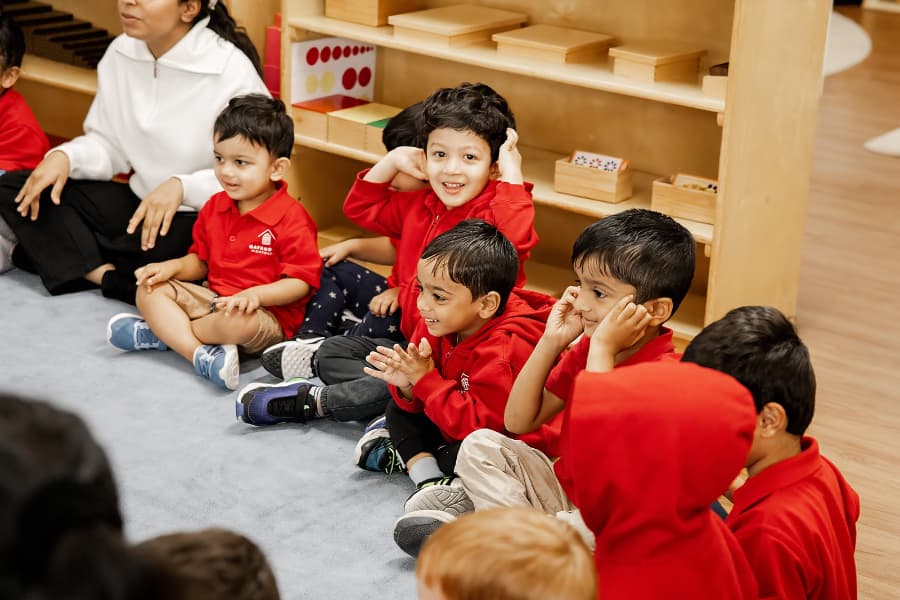
Mixed-age grouping (usually a three-year span) is central. Older children reinforce their learning by helping younger ones; younger children absorb more advanced work simply by watching. The classroom becomes a small community where children practise leadership, empathy and responsibility.
Materials are self-correcting where possible. If a puzzle piece does not fit or the water spills, the child sees the result immediately and can try again without adult judgement. This builds problem-solving and resilience.
What Skills Children Develop Beyond Academics
Alongside literacy and numeracy foundations, children develop:
- Independence and self-care
- Sustained concentration and the ability to complete a task
- Fine- and gross-motor coordination
- Executive function skills (planning, focus, flexibility)
- Social confidence and respectful communication
- Intrinsic motivation — the desire to learn for its own sake
These capacities support a confident transition to school and later learning. Research into Montessori outcomes has often shown advantages in academic readiness, executive function and social understanding, though individual results always depend on the quality of the program and the child’s temperament.
Montessori Preschool in the Australian Context
In Australia, quality Montessori programs operate within the National Quality Framework and align with the Early Years Learning Framework (Belonging, Being & Becoming). The Montessori National Curriculum has been recognised by ACARA as an alternative curriculum framework. Many centres, including those following authentic Montessori practice, integrate the two approaches so children receive both the distinctive Montessori materials and experiences and the outcomes expected under Australian early childhood standards.
Parents can look for trained Montessori educators (AMI, AMS or equivalent), a prepared environment with the classic materials, and a genuine work cycle rather than a heavily adult-directed timetable.
How Montessori Compares to Traditional Preschool
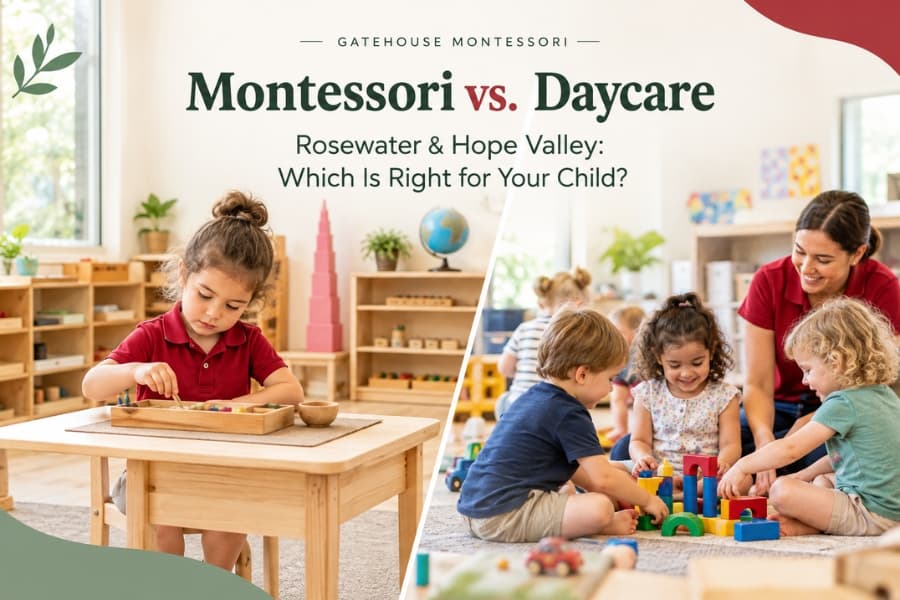
Traditional preschool programs are often more teacher-led, with group activities, shorter rotations, and a stronger emphasis on same-age social play and thematic units. Montessori is more individualised, materials-based, and focused on long periods of concentrated work and practical independence.
Neither approach is universally “better.” Some children thrive with the structure and social focus of a traditional setting; others flourish with the autonomy and depth of Montessori. The best choice depends on your child’s personality, your family values, and the quality of the specific centre.
Practical Tips for Parents Considering Montessori
- Visit during a work cycle if possible. Notice whether children are engaged, moving purposefully, and treating materials and each other with care.
- Ask about educator training and how the program balances Montessori principles with Australian regulatory requirements.
- Observe how independence is supported — can children access materials themselves? Are they expected to tidy up?
- Talk to current parents about the transition to school and any adjustments their children made.
- Remember that authentic Montessori is a three-year cycle in the Children’s House. Children benefit most when they can stay for the full period.
A good Montessori preschool does not rush academic milestones. It builds the underlying capacities — concentration, coordination, independence and curiosity — that make later academic learning more natural and enjoyable.
If you are looking for an environment where your child can develop practical skills, early literacy and numeracy foundations, refined senses, and social confidence through purposeful work, a quality Montessori preschool is worth exploring.
FAQ
What age is Montessori preschool for?
Most Children’s House programs serve children from around 2½ or 3 to 6 years. Some centres also offer toddler programs from 18 months.
Will my child learn to read and write in Montessori preschool?
Many children develop strong foundations and begin reading and writing through the multi-sensory materials. Progress is individual; some read early, others later, but the approach builds deep phonetic understanding.
Is Montessori only for certain types of children?
Montessori can suit a wide range of children, including those who need more movement, those who concentrate deeply, and those who benefit from clear order. A visit and conversation with the educators will help you assess fit.
How does Montessori prepare children for school?
Children develop independence, concentration, early literacy and numeracy skills, and the ability to work with others. These habits support a confident start to primary school.
Do Montessori preschools follow the Australian Early Years Learning Framework?
Quality programs align with or integrate the EYLF while delivering the Montessori curriculum.
What should I look for in a genuine Montessori preschool?
Trained Montessori educators, a full set of classic materials, mixed-age groups, long uninterrupted work periods, and a calm, ordered environment where children choose purposeful activity.