Montessori vs. Daycare in Rosewater & Hope Valley: Which Is Right for Your Child?
Parents in Hope Valley, Rosewater and the surrounding northern Adelaide suburbs often find themselves weighing two common options: a traditional long day care (often simply called daycare) and a Montessori early learning centre. Both can provide safe, nurturing care. The difference lies in how children spend their days, how learning is approached, and the kind of independence and concentration that is encouraged.
This guide explains the practical differences between Montessori and typical daycare so you can decide which environment is more likely to suit your child’s temperament and your family’s values. It draws on the way authentic Montessori is delivered at centres such as Gatehouse Montessori in Hope Valley and Rosewater, while remaining fair to high-quality traditional services.
Understanding the Two Approaches
Traditional long day care / daycare
Most Australian long day care centres follow the Early Years Learning Framework (EYLF). Educators plan a mix of free play, group times, intentional teaching and routines. Children are usually grouped by age. The day has a clear structure with set times for meals, outdoor play, rest and group activities. The focus is on care, socialisation, play-based learning and meeting developmental milestones.
Montessori early learning
Montessori is a specific educational approach developed by Dr Maria Montessori. Classrooms are carefully prepared environments with specialised materials. Children work in mixed-age groups, choose their own activities for longer uninterrupted periods, and develop independence, concentration and practical life skills. Educators act as guides rather than leading every activity. Authentic Montessori programs still operate under the National Quality Framework and align with the EYLF, but the daily experience looks and feels different.
Neither approach is automatically “better”. Quality of relationships, consistency of educators and the overall atmosphere matter enormously in both settings.
Key Differences at a Glance
| Aspect | Typical Daycare / Long Day Care | Authentic Montessori |
|---|---|---|
| Classroom grouping | Same-age rooms | Mixed-age (usually 2½–6 or similar span) |
| Daily rhythm | Structured schedule with group times | Longer uninterrupted work cycles |
| Choice of activity | Educator-planned experiences + free play | Child chooses from prepared materials |
| Educator role | Leads activities, manages group routines | Observes, presents materials, guides |
| Materials | Toys, craft, themed resources | Purpose-designed, self-correcting Montessori materials |
| Learning focus | Play-based + intentional teaching | Independence, concentration, practical life + academics through materials |
| Environment | Often bright, activity zones | Orderly, calm, natural materials, child-height shelves |
The Learning Environment and Daily Rhythm
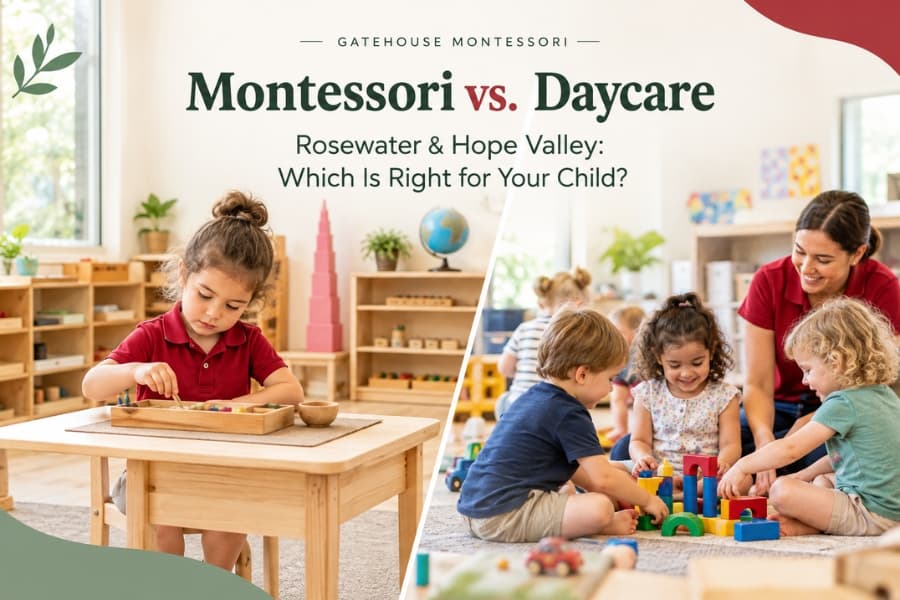
In many daycare rooms you will see colourful walls, plastic toys, activity stations and a group mat for circle time. The day moves through planned blocks: morning tea, outdoor play, group story or music, lunch, rest, and more play.
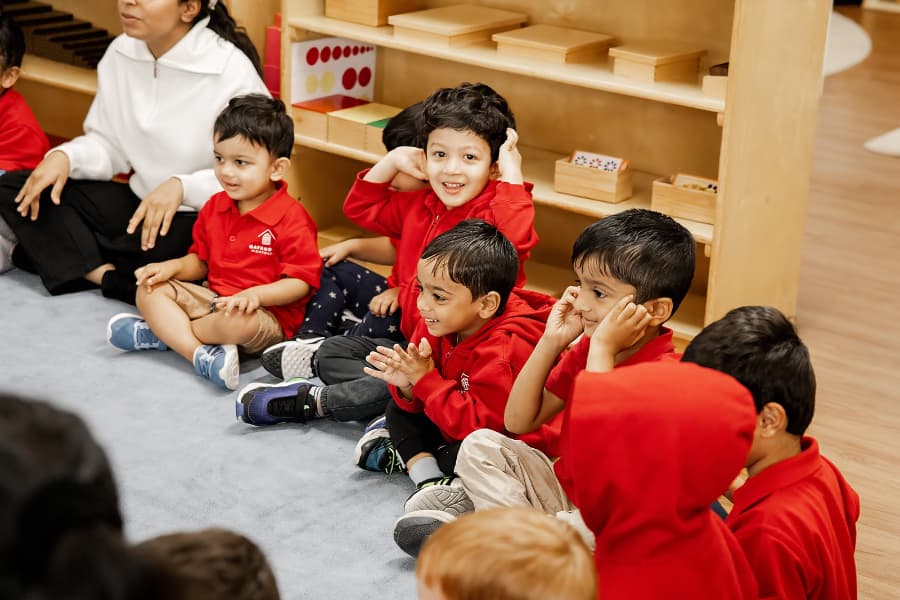
A Montessori classroom looks quieter and more ordered. Low open shelves hold wooden and natural materials arranged by curriculum area (Practical Life, Sensorial, Language, Mathematics, Culture). Children select work, carry it to a mat or table, concentrate for as long as they need, and return it ready for the next child. There is usually a three-hour morning work cycle with minimal interruption. Outdoor time, meals and rest still happen, but the emphasis is on sustained, self-directed activity.
At Gatehouse Montessori the full-day program runs from 7:30 am to 6:00 pm, with the core Montessori work cycle typically focused in the morning. This structure supports both working families and deep concentration.
The Role of Educators
In traditional settings educators often lead group experiences, manage transitions and facilitate play. They plan according to the EYLF and observe children against learning outcomes.
In Montessori the educator’s role is more observational and precise. They present individual or small-group lessons on specific materials, then step back so the child can practise independently. The goal is to foster intrinsic motivation rather than constant adult direction. High-quality Montessori educators hold both early childhood qualifications and specialised Montessori training.
Social Development and Mixed-Age Groups
Same-age rooms make it easy for children to play with peers at a similar developmental stage. Group games, songs and shared projects build belonging.
Mixed-age Montessori classrooms create a different social dynamic. Younger children learn by watching older ones; older children reinforce their own learning by helping. Grace and courtesy lessons explicitly teach social skills, conflict resolution and respect. Many parents notice their children become more independent and capable of working alongside others without constant adult mediation.
Materials, Independence and School Readiness
Montessori materials are designed to isolate one concept at a time and allow self-correction. A child working with the pink tower or number rods receives immediate feedback from the material itself. Practical Life activities (pouring, sweeping, food preparation, dressing frames) build coordination, concentration and real-life competence.
Traditional daycare offers rich play experiences, creative expression and social learning that also support school readiness. The difference is one of emphasis: Montessori places stronger focus on independent work habits, fine motor precision and self-paced academic foundations through the materials.
Both approaches can prepare children well for school. The best fit depends on whether your child thrives with more structure and group energy or with longer periods of focused, self-chosen work.
Quality Frameworks in Australia
All approved long day care and Montessori centres in Australia operate under the National Quality Framework (NQF) and are assessed against the National Quality Standard (NQS). They must also use the Early Years Learning Framework. You can check any service’s current rating on the Starting Blocks website.
Authentic Montessori centres map their practice to the EYLF outcomes while using the distinctive Montessori curriculum and materials. When you visit, ask how the service demonstrates quality in educational program and practice (Quality Area 1) and relationships with children (Quality Area 5).
Practical Considerations for Local Families
Location and hours
Hope Valley and Rosewater both have options. Gatehouse Montessori offers centres in each suburb with full-day care (7:30 am–6:00 pm) and a focused Montessori cycle. Traditional long day care is more widely available across the northern suburbs.
Cost and subsidies
Both types of service can access Child Care Subsidy for eligible families. Fees vary; contact centres directly for current rates and gap-fee estimates.
Availability
Popular Montessori places can have waitlists because group sizes are often intentionally kept smaller to preserve the prepared environment. Start touring early.
Your child’s temperament
Some children settle quickly into a lively, structured daycare room. Others blossom when given space to concentrate and choose their work. Observation on a tour is the best guide.
How to Decide What’s Right for Your Child
- Clarify what matters most to your family – independence, social energy, academic foundations, flexibility of hours, or a calm atmosphere.
- Visit both types of service during operating hours.
- Watch the children: Are they engaged? Do interactions feel respectful?
- Ask about the daily rhythm, how individual needs are met, and how the service works with the EYLF.
- Talk to the educators about your child’s personality and any specific needs.
- Trust the combination of evidence, observation and your parental instinct.
Many families find that once they understand the real differences, the choice becomes clearer. High-quality care exists in both Montessori and traditional long day care settings in Hope Valley and Rosewater. The right environment is the one where your child feels secure, curious and capable.
FAQ
Is Montessori just a type of daycare?
No. While Montessori centres provide care and operate under the same national regulations, the educational philosophy, materials, mixed-age grouping and daily work cycle are distinct from most traditional long day care programs.
Does Montessori prepare children for school?
Yes. The focus on concentration, independence, practical life skills and early literacy and numeracy through hands-on materials supports a confident transition to school for many children.
Are Montessori educators more qualified?
Authentic Montessori educators usually hold both standard early childhood qualifications and specialised Montessori training. Always ask about the specific training of the team at any centre you visit.
Can my child still play and be social in Montessori?
Yes. Children interact freely, work alongside peers, and learn social skills through grace and courtesy lessons and mixed-age relationships. Outdoor play and group moments still occur.
Is one more expensive than the other?
It varies by service. Check current fees and Child Care Subsidy estimates with each centre.
How do I know if a centre is truly Montessori?
Look for a prepared environment with genuine Montessori materials, mixed-age groups, long work cycles, and educators who can explain the philosophy. Ask about Montessori-specific training.