
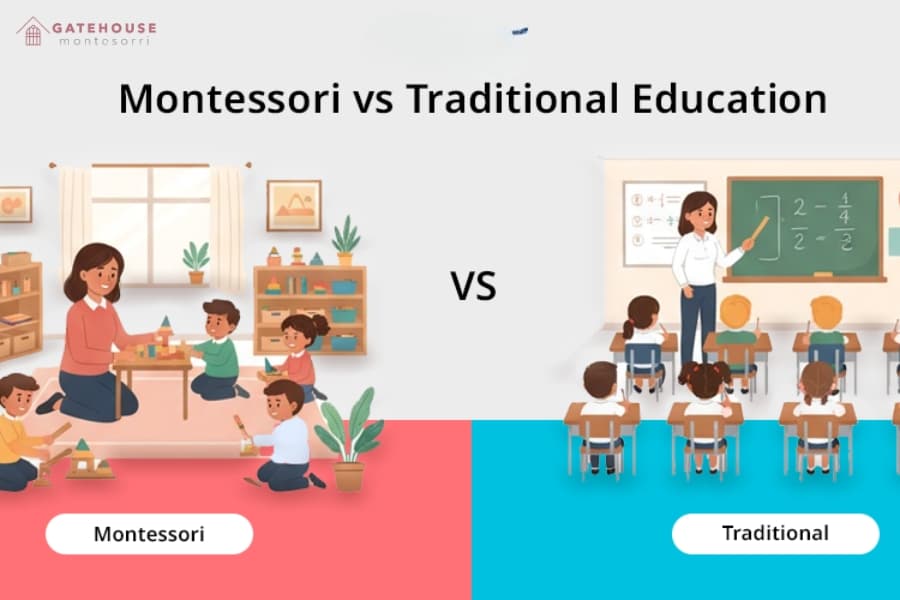
Montessori vs. Traditional Daycare: Which Approach Is Right for Your Child?
Choosing childcare is one of the most important decisions parents make in the early years. You want a place where your child feels safe, grows confidently, and develops a genuine love of learning. Two popular options stand out: Montessori programs and traditional daycare centers.
At first glance they may look similar — both care for young children during the day. Look closer and the differences become clear. One follows a carefully designed educational philosophy developed over a century ago. The other typically focuses on structured group care, play, and age-based routines.
This guide walks you through both approaches in detail so you can decide what fits your child and family best. We will cover philosophy, classroom experience, daily schedules, social development, academic readiness, cost considerations, and practical tips for making the choice.
Table of Contents
What Is Montessori Education?
What Is Traditional Daycare?
Core Philosophical Differences
Classroom Environment and Materials
Role of the Teacher or Guide
Daily Schedule and Structure
Social and Emotional Development
Academic and Cognitive Outcomes
Mixed-Age vs Same-Age Grouping
Pros and Cons Comparison
Which Children Thrive in Each Setting?
Cost, Availability, and Practical Considerations
How to Evaluate a Program in Person
Common Mistakes Parents Make
Expert Recommendations
Key Takeaways
Frequently Asked Questions
Final Checklist
What Is Montessori Education?
Montessori education was developed by Dr. Maria Montessori, an Italian physician and educator, in the early 1900s. She observed that children learn best when they are free to explore within a carefully prepared environment that matches their developmental stage.
The approach rests on several core ideas:
Children have an “absorbent mind” in the early years and naturally soak up knowledge from their surroundings.
They pass through “sensitive periods” when they are especially ready to learn specific skills (language, order, movement, social relations, etc.).
Independence, concentration, and intrinsic motivation are more valuable than external rewards or adult-directed instruction.
The adult’s role is to observe, prepare the environment, and guide rather than lecture or control.
In a true Montessori classroom for toddlers and preschoolers, you will see low shelves with carefully designed materials, children choosing their own work, mixed-age groups, and a calm atmosphere of purposeful activity.
Montessori is not simply a teaching method. It is a complete view of the child as a capable, curious learner who deserves respect and autonomy within clear boundaries.
What Is Traditional Daycare?
Traditional daycare (sometimes called conventional or standard early childhood programs) varies widely, but common features include:
Age-grouped classrooms (for example, all 2-year-olds together)
Teacher-led group activities, circle time, and planned lessons
A mix of free play, structured play, and adult-directed learning
Emphasis on socialization, routines, and basic school readiness skills
Caregivers who often take a more active directing role throughout the day
Many traditional centers follow state licensing standards and may incorporate elements of play-based learning, HighScope, or other early childhood frameworks. Quality ranges from basic custodial care to excellent programs with trained early childhood educators.
Traditional daycare prioritizes reliable care, social interaction with peers of the same age, and a predictable daily rhythm that many families find comforting.
Core Philosophical Differences
The biggest distinction lies in how each approach views the child and the process of learning.
Montessori view:
The child is an active constructor of knowledge. Adults prepare the conditions for learning and then step back. Choice, repetition, and concentration are protected. Mistakes are viewed as part of the learning process.
Traditional daycare view:
Adults play a more central role in planning activities, managing the group, and teaching specific skills. Learning often happens through group experiences, songs, stories, and teacher-led lessons. Free play is usually balanced with structured time.
These differences shape almost everything that follows — the furniture, the materials, the schedule, the language adults use with children, and the way conflicts are handled.
Classroom Environment and Materials
Walk into a high-quality Montessori classroom and you will notice order, beauty, and accessibility. Materials are displayed on low open shelves. Each material has a specific purpose and is designed to isolate one concept (for example, size, color, or quantity). Children are shown how to use the materials and then allowed to practice independently.
Typical Montessori materials for young children include:
Practical life activities (pouring, spooning, buttoning, sweeping)
Sensorial materials that refine the senses
Language materials (sandpaper letters, object matching)
Early math materials (number rods, spindle boxes)
Cultural materials that introduce geography, biology, and art
In many traditional daycare rooms you will see brighter colors, more plastic toys, theme-based decorations, dramatic play centers, block areas, and art supplies. The environment is often richer in variety but less deliberately sequenced. Toys and materials may be rotated according to themes or seasons rather than following a precise developmental progression.
Both environments can be warm and inviting. The key difference is intentionality. Montessori environments are prepared with scientific precision to support independence and concentration. Traditional environments often prioritize stimulation, variety, and group engagement.
Role of the Teacher or Guide
In Montessori, the adult is called a guide or director. Their primary jobs are careful observation, preparing and maintaining the environment, giving precise lessons when a child is ready, and protecting the child’s concentration. They rarely interrupt a focused child and avoid excessive praise or rewards.
In traditional daycare, teachers more often lead group activities, manage transitions, facilitate play, and provide direct instruction or redirection throughout the day. The adult presence tends to be more visible and directive.
Neither role is inherently better. Some children flourish with greater autonomy. Others feel more secure with clearer adult direction and frequent interaction.
Daily Schedule and Structure
A typical Montessori morning includes a long, uninterrupted work period (often two to three hours). During this time children choose activities, work individually or in small groups, and move freely within the classroom. Group gatherings are usually shorter and less frequent.
Traditional daycare schedules are often more segmented: arrival and free play, circle time, snack, outdoor play, lunch, rest, afternoon activities, and more free play. Transitions happen more frequently, and the whole group usually follows the same sequence.
The longer work cycle in Montessori supports deep concentration. The more varied schedule in traditional settings can feel energetic and socially rich.
Social and Emotional Development
Montessori classrooms are mixed-age (typically three-year age spans). Older children naturally help younger ones, reinforcing their own learning and building empathy. Conflict resolution is taught deliberately, and children are guided to solve problems with increasing independence.
Traditional programs usually keep children with same-age peers. This can create strong peer bonds and age-appropriate social challenges. Teachers often mediate conflicts more directly and use group discussions or social-emotional curricula.
Research suggests Montessori environments can support strong executive function, independence, and positive attitudes toward school. High-quality traditional programs also produce excellent social and emotional outcomes when teachers are skilled and responsive.
Academic and Cognitive Outcomes
Multiple studies, including meta-analyses, have found that Montessori education is associated with advantages in language, math, executive function, and creativity compared with traditional approaches, particularly in the preschool and elementary years. Effect sizes are generally modest to moderate but consistent across well-designed studies.
Traditional daycare that includes strong language-rich interactions, responsive caregiving, and play-based learning also prepares children well for school. The quality of the specific program and the skill of the adults matter more than the label.
No single approach guarantees success. The fit between the child, the family, and the specific program is what counts most.
Mixed-Age vs Same-Age Grouping
Montessori advantage: Older children model advanced skills and develop leadership. Younger children are inspired by what they see. The community feels more like a family.
Traditional advantage: Curriculum and expectations can be tightly matched to developmental norms for that exact age. Peer relationships form among children at similar stages.
Some children love the mentorship opportunities of mixed ages. Others prefer the camaraderie of same-age groups.
Pros and Cons Comparison
Montessori Pros
Strong focus on independence and self-motivation
Beautiful, orderly environments designed for concentration
Mixed-age community that builds empathy and leadership
Hands-on materials that support deep conceptual understanding
Respectful, calm atmosphere
Research support for academic and executive function benefits
Montessori Cons
Can feel less socially stimulating for highly social children
Availability and cost can be limiting
Quality varies — not every program labeled “Montessori” follows authentic practice
Less emphasis on large-group activities and teacher-led fun
May require adjustment for children used to constant adult direction
Traditional Daycare Pros
Often more widely available and sometimes more affordable
Predictable group routines many children find comforting
Strong same-age peer interactions
Greater variety of play materials and themed activities
Easier transition for some children into conventional elementary schools
Flexible options (part-time, extended hours) in many centers
Traditional Daycare Cons
Quality varies enormously
More transitions can interrupt deep play or concentration
Teacher-directed style may reduce opportunities for self-direction
Environments can feel overstimulating
Less emphasis on precise developmental materials
Which Children Thrive in Each Setting?
Montessori often suits children who:
Enjoy focused, independent work
Are naturally curious and self-directed
Benefit from calm, orderly environments
Respond well to clear expectations and freedom within limits
Have families who value independence and intrinsic motivation
Traditional daycare often suits children who:
Are highly social and energised by group activities
Prefer more adult interaction and guidance
Thrive with variety and frequent changes of activity
Need a setting that closely mirrors future conventional school structures
Have families seeking greater scheduling flexibility or lower cost
Many children can thrive in either environment when the program is high quality and the adults are responsive.
Cost, Availability, and Practical Considerations
Authentic Montessori programs, especially those with trained teachers and proper materials, are often more expensive and less widely available than traditional daycare. Public Montessori options exist in some school districts and can change the cost equation.
Traditional centers are more common and may offer longer hours, drop-in care, or sliding-scale fees. Always verify licensing, staff-to-child ratios, teacher qualifications, and turnover rates regardless of philosophy.
Ask about:
Teacher training and credentials
Staff turnover
Daily schedules and how much uninterrupted time children have
How discipline and conflict are handled
Parent communication practices
Outdoor time and nature exposure
How to Evaluate a Program in Person
Visit during operating hours if possible. Observe:
Are children engaged and calm, or restless and waiting?
Do adults speak respectfully and at the child’s level?
Is the environment orderly and accessible to children?
How do adults respond when a child makes a mistake or has a conflict?
Do children have real choices, or is everything tightly controlled?
How does the program handle transitions and group times?
Talk with the director and teachers about their philosophy in practice, not just on paper. Ask for parent references.
Common Mistakes Parents Make
Choosing based on the label alone without observing the actual classroom
Assuming more expensive always means better
Ignoring their own child’s temperament and preferences
Overlooking staff stability and ratios
Failing to consider the commute and daily logistics
Expecting any single program to meet every need
The best program is the one that works for your specific child and family in real daily life.
Expert Recommendations
Early childhood specialists generally agree on several points:
Quality of relationships between adults and children matters more than any particular curriculum.
Look for responsive, warm, and consistent caregivers.
Environments that allow uninterrupted play or work support deeper learning.
Parent-program partnership improves outcomes.
Observe your child after a few weeks — are they happy, tired in a good way, and growing in confidence?
If possible, try a short trial period or extended visit before committing long-term.
Quick Summary Box
Montessori emphasizes child-led learning, independence, mixed ages, and carefully designed materials in a calm, ordered environment.
Traditional daycare typically features same-age groups, more teacher direction, varied play experiences, and structured daily routines.
Neither is universally superior. The right choice depends on your child’s personality, your family’s values, practical constraints, and the quality of the specific program you are considering.
Key Takeaways
Montessori and traditional daycare differ in philosophy, environment, adult role, and daily rhythm.
Research shows advantages for Montessori in some academic and executive function outcomes, but high-quality traditional programs also support strong development.
Child temperament and family priorities should guide the decision.
Always evaluate the actual classroom and staff, not just the name.
A good fit supports your child’s confidence, curiosity, and sense of security.
Checklist: Choosing Between Montessori and Traditional Daycare
I have observed both types of programs in person
I understand my child’s temperament and preferences
I have checked teacher qualifications and turnover
The daily schedule works with our family logistics
The program’s values align with ours
Cost and location are realistic long-term
I have spoken with current parents
I feel confident the adults will treat my child with respect
Frequently Asked Questions
Is Montessori only for gifted or advanced children?
No. Montessori was designed for all children and has been used successfully across a wide range of abilities and backgrounds.
Can a traditional daycare incorporate Montessori ideas?
Yes. Many centers borrow elements such as practical life activities or greater child choice while remaining primarily traditional.
Will my child struggle if they move from Montessori to a traditional elementary school?
Most children adapt well. The independence and concentration skills developed in Montessori often transfer positively.
How important is official Montessori teacher training?
Very important for authentic practice. Look for credentials from recognized organizations such as AMI or AMS.
What age is best to start Montessori?
Many programs accept children from infancy or toddlerhood. The earlier years are considered especially valuable because of the absorbent mind.